
UAE Labour Law 2026: A Complete Compliance Checklist for HR Teams
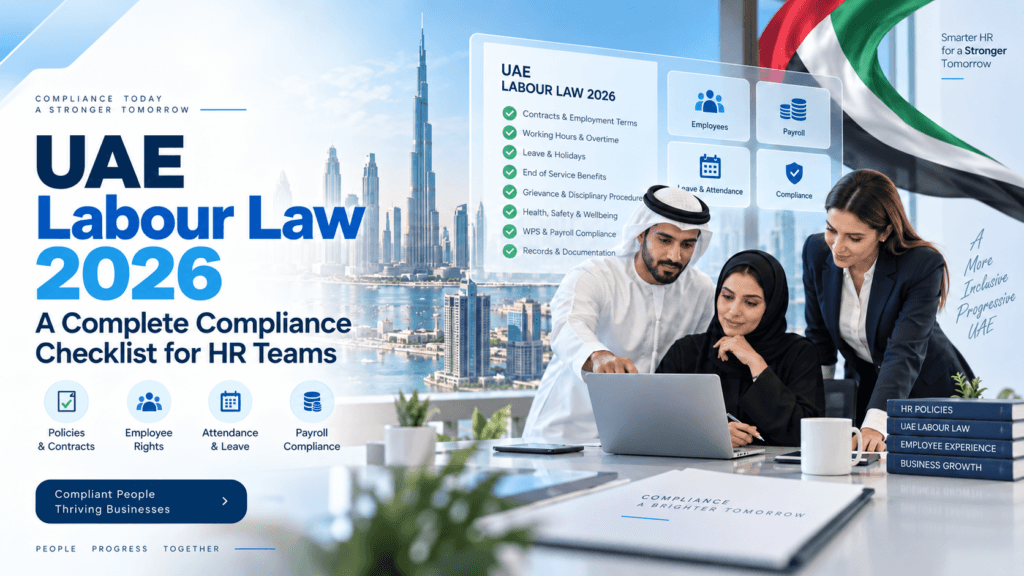
For HR teams in the UAE, labour-law compliance is not something that should be checked only when an employee joins or leaves the company. It affects employment contracts, working hours, payroll, leave, employee records, workplace conduct and end-of-service calculations throughout the employment lifecycle.
The main federal legislation governing private-sector employment is Federal Decree-Law No. 33 of 2021 Regarding the Regulation of Employment Relationships, together with its amendments and implementing regulations. For HR departments, the practical challenge is turning these legal requirements into repeatable processes that can be monitored consistently.
1. Review Employment Contracts and Employee Records
First, HR teams should ensure that every employee has appropriate employment documentation and that the information maintained internally matches the employee’s official employment records. In addition, private-sector employment relationships under the UAE Labour Law are based on fixed-term contracts, which may be renewed or extended.
Maintain an employment contract for every employee
Record contract start and expiry dates
Keep employee personal and identification information up to date
Track work permits and relevant employment documents
Record amendments to salary, designation or employment terms
Retain appropriate HR records for audit and operational purposes
An HRMS can make this easier by centralising employee documents and automatically alerting HR teams before contracts, visas or other important documents expire.
2. Monitor Working Hours, Attendance and Overtime
Working-time compliance is another important responsibility for UAE HR departments.For most private-sector employees, normal working hours are eight hours per day or 48 hours per week, subject to exceptions for certain sectors and categories of employees. During Ramadan, normal working hours for private-sector employees are reduced by two hours per day.
Daily working hours
Weekly working hours
Late arrivals and early departures
Approved overtime
Weekly rest days
Public holidays
Ramadan working-hour adjustments
In addition, attendance records should connect correctly with payroll calculations. Manual spreadsheets can become difficult to control once an organisation has several departments, shifts or locations.
3. Manage Employee Leave Correctly
Leave administration is an area where HR teams need both clear policies and accurate employee balances.The UAE Labour Law provides employees with statutory leave entitlements, including annual leave and other categories of leave subject to the applicable conditions.
Annual leave entitlement
Leave accrued
Leave already taken
Remaining balance
Carry-forward arrangements
Leave compensation when employment ends
Therefore, employees should have their annual leave properly scheduled, recorded and reflected in payroll in accordance with the law.
4. Keep Payroll, Wages and End-of-Service Records Accurate
Payroll compliance is one of the most sensitive responsibilities of an HR and payroll department. HR teams should verify that salary components in the system match the employee’s employment terms and that payroll records clearly distinguish between basic salary and other allowances where necessary.
Basic salary
Allowances
Overtime
Leave-related payments
Deductions
Salary adjustments
Final settlement calculations
End-of-service gratuity
Finally, when an employee leaves the organisation, HR should ensure that the final settlement is calculated based on the applicable legal and contractual requirements.
5. Maintain Fair Workplace Policies and HR Procedures
Compliance is not limited to payroll and contracts. The UAE Labour Law also contains protections concerning discrimination, harassment, bullying, forced labour and workplace conduct. For example, HR departments should maintain clear policies explaining acceptable workplace behaviour and establish procedures for employees to report concerns.
Anti-discrimination policies
Anti-harassment and bullying policies
Employee grievance procedures
Disciplinary procedures
Confidential handling of employee complaints
Documented investigation and approval processes
Consistent application of company policies
6. Audit HR Compliance Regularly
One of the safest approaches is to treat labour-law compliance as an ongoing process rather than an annual exercise.As a result, HR teams can schedule monthly or quarterly reviews covering contracts, employee documents, leave balances, payroll records and approaching expiry dates.
Contracts nearing expiry
Missing employee documents
Upcoming visa or ID expiry dates
Excessive leave balances
Pending attendance approvals
Unresolved payroll adjustments
Employees approaching probation or contract milestones
Final HR Compliance Checklist for 2026
Before considering your HR processes compliant, review whether your organisation can answer “yes” to the following:
Does HR keep all employee contracts properly recorded and current?
Does HR monitor employment and identification documents for expiry?
Does the company record working hours and overtime accurately?
Does HR apply Ramadan working-hour rules correctly?
Does HR maintain employee leave balances accurately?
Does HR document payroll and salary components properly?
Does HR support end-of-service calculations with reliable records?
Does the company maintain workplace conduct, grievance and anti-discrimination policies?
Can HR access historical employee records when required?
Does HR perform compliance checks regularly rather than only when problems occur?
UAE labour compliance becomes much easier when HR data is maintained consistently from onboarding through final settlement. A well-configured HRMS can support this process by keeping employee records, attendance, leave, payroll, documents and approvals together in one system. Businesses evaluating HRMS software Dubai solutions should look for a system that can support these processes in a structured and reliable way.
However, businesses should remember that labour regulations and ministerial decisions can change. HR teams should regularly review official UAE Government and Ministry of Human Resources and Emiratisation updates and obtain professional legal advice where a specific employment matter requires interpretation.