
Emiratisation Targets 2026: Year-End Deadline Checklist for UAE Employers
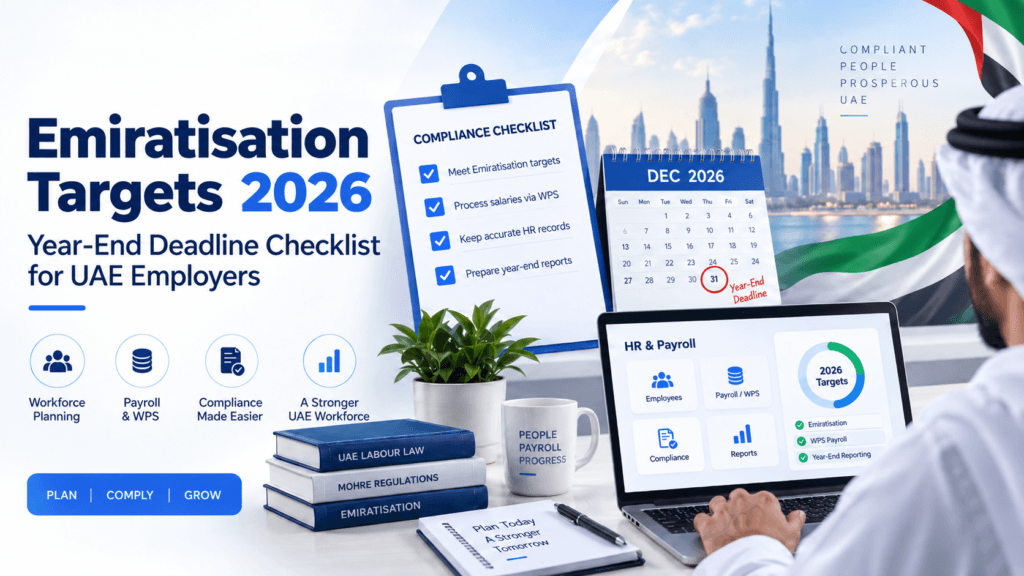
`If your company has 50 or more employees in the UAE, the year-end deadline is the one to plan for now. The Emiratisation targets 2026 set by the Ministry of Human Resources and Emiratisation (MoHRE) must be met by 31 December, and companies that prepare early avoid last-minute hiring pressure and financial contributions.
This guide explains what the targets are, who is covered, what happens if you miss them, and a practical checklist your HR team can follow before the year ends.`
What Are the Emiratisation Targets for 2026?
`Private-sector companies with 50 or more employees must increase the number of Emiratis in skilled positions by 2% every year. The target is split across the year: a 1% increase in the first half (deadline 30 June) and another 1% in the second half, bringing the total to 2% by 31 December 2026.
MoHRE has also stated that financial contributions apply from 1 July 2026 to establishments that missed the first-half target. If that includes your company, you should confirm your position with MoHRE and plan to close the gap before year end.`
Which Companies Are Covered?
Companies with 50 or more employees: required to achieve the annual 2% growth in skilled Emirati positions.
Companies with 20 to 49 employees in designated sectors: MoHRE has extended Emiratisation requirements to some fast-growing sectors. Check whether your sector is included.
Smaller companies: not under the mandate, but they can still use MoHRE’s Nafis programme to hire Emirati talent.
Always confirm your exact obligation with MoHRE, because requirements depend on your headcount, sector and skill classification.
What Happens If You Miss the Target?
Companies that fall short of their Emiratisation rate are required to pay financial contributions, and MoHRE has warned of penalties and possible downgrades for non-compliance. The ministry is also monitoring “fake Emiratisation”, where Emiratis are registered without genuine employment. Companies found doing this can face serious penalties.
The safest approach is real, documented hiring and retention.
Year-End Emiratisation Checklist
Calculate your baseline. Count your skilled positions and your current Emirati headcount, then work out how many hires you need to reach the 2% target.
Review your first-half result. If you missed the 30 June target, confirm any contributions and build a catch-up plan.
Start recruitment through Nafis. MoHRE encourages employers to use the Nafis platform to reach Emirati job seekers. Hiring, offer, onboarding and registration take weeks, so start now rather than in December.
Register every Emirati employee correctly. Make sure all Emirati staff are registered in the pension and social security system.
Pay salaries through WPS. Salaries must go through the Wage Protection System on time and accurately. Keep clean payroll records for every pay cycle.
Plan for retention. Meeting the target once is not enough. Offer onboarding support, mentoring and clear career paths so Emirati hires stay.
Keep documentation ready. Contracts, payroll, attendance and leave records help you prove genuine employment if MoHRE asks.
Avoid shortcuts. Never register Emiratis without real roles. The penalties are far higher than the cost of proper hiring.
How an HRMS Helps You Stay Compliant
Emiratisation compliance is mostly a data and process problem. HR teams need accurate employee records, on-time WPS payroll, and reports they can trust. Doing this in spreadsheets makes errors more likely, especially near the deadline.
A modern HR software in Dubai like Delta HRMS helps by bringing these together in one system:
Centralised employee management with all records and documents in one place
WPS-compliant payroll processing
Document expiry alerts so nothing lapses unnoticed
Attendance and leave tracking linked directly to payroll
Reports that give HR and management a clear view of the workforce
With clean data in one place, tracking your progress toward the year-end target becomes much easier.
Frequently Asked Questions
Who must meet the Emiratisation targets in 2026?
Private companies with 50 or more employees must achieve 2% annual growth in skilled Emirati positions. Some companies with 20 to 49 employees in designated sectors also have requirements. Confirm your status with MoHRE.
What is the year-end deadline?
The full-year target must be met by 31 December 2026. The first-half target of 1% had a 30 June deadline.
What is Nafis?
Nafis is a government programme that helps private-sector employers connect with Emirati job seekers and supports Emiratisation.
Do salaries have to go through WPS?
Yes. Private-sector companies registered with MoHRE must pay salaries electronically through the Wage Protection System.
Can HR software help with Emiratisation?
HR software cannot replace hiring, but it keeps employee records, payroll and reports accurate and organised, which makes compliance easier to manage and prove.
Get Ready Before the Year Ends
The final quarter is when many companies rush. Start early, keep your records clean, and use the right tools. Want to see how Delta HRMS can simplify payroll, WPS and workforce reporting for your company? Book a free demo today.
This article is for general information and reflects MoHRE announcements at the time of writing. Please confirm current requirements with MoHRE before making compliance decisions.